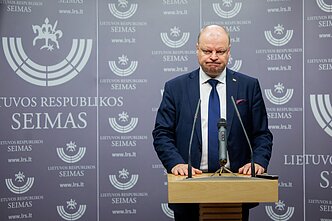





Lithuania’s parliament approved on Tuesday the establishment of a new military training grounds on Tuesday during the bill’s second reading. A final reading is still needed for the project to pass.
“I am satisfied with the decision itself – that the training ground law is understood as a matter of national importance and security necessity [...] and that the Seimas has the will to adopt the law,” Defence Minister Robertas Kaunas told reporters after the vote.
Previously, he said the location was chosen due to it being located in the so-called Suwalki Gap, a narrow strip of land between Belarus and Russia’s Kaliningrad exclave. NATO and Baltic officials say the area could be a potential flashpoint in case of a military conflict.
The second reading of the bill in the Seimas was supported by 109 MPs, with 11 voting against and two abstaining. All opposing votes came from within the ruling majority, including eight lawmakers from the Nemunas Dawn party and three members of the Lithuanian Farmers, Greens and Christian Families Union.
The first reading in the parliament last month passed only with support from opposition MPs, sparking a short-lived crisis within the coalition government.

Discussions over compensation
The grounds will cover approximately 14,600 hectares, which includes nearly 2,000 private plots, the majority of which are forest land.
The Defence Ministry has proposed compensating owners of expropriated property, which will be bought out by the government, with an additional €52,000 as compensation.
Owners of property located in the training area would have 10 years to decide whether they wish to relocate; if they choose to do so, they would receive €25,000 in compensation in addition to the value of their property.
The ministry aims for the training ground to become fully operational by 2030, with the first drills to be held in 2028.
Local residents stage protest in Vilnius
Previously, there were several protests by local residents, as well as by fringe political figures who backed the demonstrations. Many of the local residents say they were excluded from the decision-making process.
Several hundred people also protested outside parliament on Tuesday, citing concerns over deforestation and environmental damage.
While municipal authorities had issued a permit for up to 5,000 protesters, approximately 300 people attended the rally, according to local officials.
Organisers demanded that decisions regarding Lithuania's forests be made "responsibly and with a view to long-term national interests".
"We must stop the destruction of Lithuanian forests. We cannot allow them to be turned into industrial and war zones," Gintautas Kniukšta, chairman of the For Lithuanian Forests movement, told reporters.
"It is incomprehensible why the military needs to train specifically in the Kapčiamiestis forest, which is an exceptionally valuable woodland," Kniukšta said.
Kniukšta described the current state of Lithuanian forestry as "tragic", saying that landscape reserves and protected areas are being logged for timber exports without creating domestic value.
He urged parliament to suspend deliberations and consult the public to determine if the project complies with European and national environmental laws.
Mindaugas Docaitis, an environmentalist with the Forest Inspection organisation, said the loss of mature forests was the most painful aspect of the plan.
He warned that habitats for the western capercaillie, a protected bird species, would be irreversibly destroyed. "Environmentalists are living in an illusion if they think these animals will simply relocate," Docaitis said.
Gražina Juškienė, a Vilnius-based painter, expressed deep concern for the ancient woodlands. "I have travelled to paint these beautiful old forests; they are a unique gift. Those who want to cut them down did not plant them or grow them – what right do they have to decide their destruction?" she said.
On the eve of the protest, Defence Minister Kaunas dismissed claims of significant environmental impact.
"Logging within the firing range area will be prohibited, except for what is strictly necessary for infrastructure. Today, this entire forest is classified as commercial woodland intended for harvesting," Kaunas told reporters.
"There are commitments to protect reserves and relocate capercaillies. Once the infrastructure is in place, the territory will actually be better protected than it is now," the minister added, noting that cleared areas would be replanted in coordination with the Environment Ministry.

Newsletter
Every Friday morning.