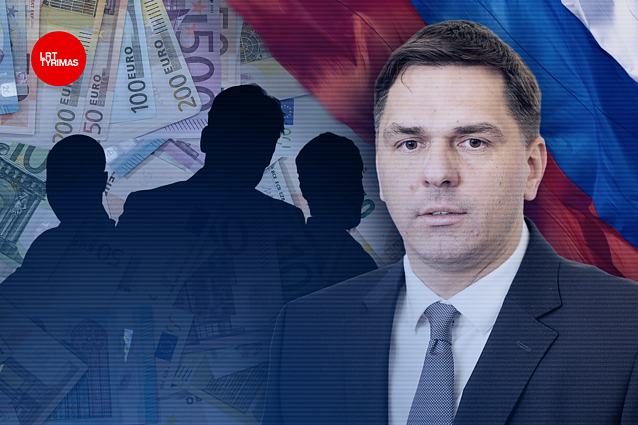


Thinking he was speaking to a Hungarian official, Lithuania’s disgraced culture minister from the populist Nemunas Dawn party disclosed he had business links to Russia. LRT’s Investigation Team decided to dig deeper, ultimately discovering a trail leading to an interest-free loan and links to people from Russia and occupied Donetsk.
Last week, civic activist Karolis Žukauskas published a conversation with Ignotas Adomavičius, a former culture minister and a parliamentary adviser to the leader of the Nemunas Dawn party, Remigijus Žemaitaitis.
Posing as Tristan Satongi, an adviser to Hungary’s foreign minister, Žukauskas discussed a potential business mission with Adomavičius. During the conversation, Adomavičius mentioned a specific business that could allegedly expand into Hungary.
“They are fertiliser producers. One is a logistics company, but their logistics are mainly linked to oil [...] they transport petrol, diesel or even crude oil. They are very big in this field,” Mr Adomavičius said.
“Now it is called Enigma, but before it was Luna Capital Group. They were from Latvia, but they were pressured by the Lithuanian government, so they changed the name because they were growing too fast and did not want a monopoly.
I know the head, he has very good connections with major companies […] such as Neste, Shell and even Gazprom. It is not popular to talk about this now, but they have an office in Switzerland anyway,” Žukauskas quoted Adomavičius as saying.
Adomavičius, revealing his links to Luna Capital Group, helped uncover the trail leading to Russia.
Luna Capital Group operated from 2009 and was deregistered in 2025 after bankruptcy. Since 2015, its sole shareholder was Russian citizen Alexander Kotov, who had a registered address in Klaipėda.
Kotov was also registered in Russia, in Moscow and in the Smolensk region. There is also information that in 2012, he was convicted under Russia’s criminal code and, in an attempt to avoid a court ruling on asset confiscation, provided false information about his assets for several years.
After Kotov became a shareholder, former Lithuanian MP Ričardas Žurinskas (1993–1996 term) was appointed director of Luna Capital Group. Bankruptcy proceedings began in mid-2016.
In his conversation with Žukauskas, Adomavičius said Luna Capital Group had been reborn as Enigma.
However, information gathered by the LRT Investigation Team shows that in Lithuania, the company re-emerged as Atgima. Its shareholder is Žurinskas’s son, while the former MP himself has been serving as director since March. Atgima operates as a freight forwarding and cargo agency.
“Whatever came to mind, I mentioned it. All the names are just a coincidence,” Adomavičius later told the Delfi news website.
Russian ‘business angels’
Adomavičius and Žurinsas had more joint ventures.
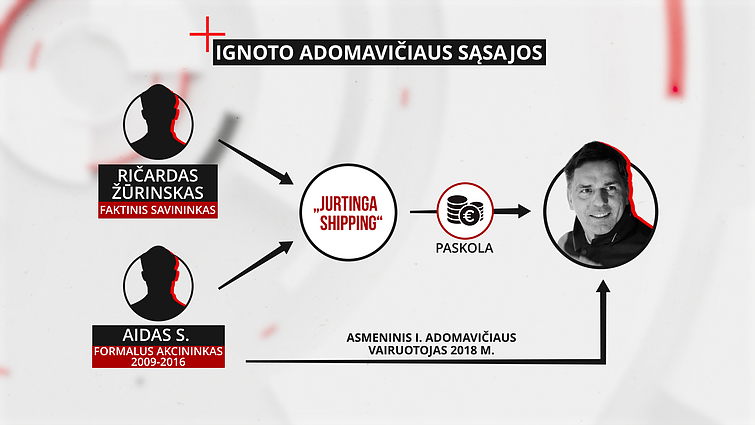
At roughly the same time as he became director of Luna Capital Group, Žurinskas also took over another company.
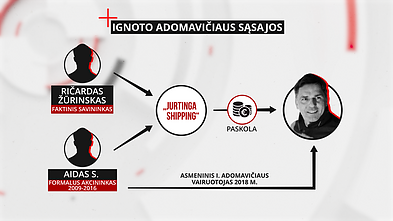
In 2015–2016, he served as director of Jurtinga Shipping – a role that ultimately resulted in a criminal conviction for fraudulent bankruptcy. At the end of 2023, Žurinskas was given a three-year prison sentence, suspended for two years.
Jurtinga Shipping was involved in freight forwarding across Eastern and Asian markets – transporting oil products by rail using leased rolling stock in Estonia and Latvia.
Among its clients were individuals deemed by the Lithuanian government in 2018 to pose a threat to national security. One example is Estonian businessman Oleg Osinovski, who represented the company AS Spacecom Trans.
Although another individual was formally listed as the owner of Jurtinga Shipping, court records show that Žurinskas was its true manager.
It was Žurinskas who, on behalf of the company, signed a loss-making wagon lease agreement with an Estonian firm, causing losses of €2.6m. He later concluded a €291,000 loan agreement with a farmer and did not demand repayment. Courts found that such actions led to the company’s bankruptcy.
The successful farmer who received the €291,000 loan in 2013 was, in fact, Adomavičius.
He reportedly repaid part of the money, but the fate of the remaining €191,000 has become a mystery.
“I know Žurinskas, why not. I do not deny it,” Adomavičius told LRT. “It goes back a long time. I used to trade in grain. In that business, you always meet people through others.”
Asked why he was granted an interest-free loan, he said: “When you are in business, in relationships with people, I was not in politics at the time. I was in business. And when relationships exist, loans are sometimes given under certain circumstances. Some get them, some do not. Some get a million, others ten million. There are business ‘angels’ who give one or two million if the idea is good. These are certain arrangements.”
Speaking to LRT, Adomavičius initially insisted he had repaid the loan. “Everything has been settled,” he said.
However, when asked how he repaid a bankrupt company, he became evasive.
“That is not your business… not journalists’ business – who and how. [...] If I do not owe, then I do not owe. Why should anyone care?” he said.
Court documents state that Jurtinga Shipping sought to avoid receiving cash repayments from Adomavičius, even though it was already insolvent. In 2015, the outstanding loan was assigned to UK-based Base Energy Limited for a striking price of $1m.
The LRT Investigation Team found that at the time, the company’s shareholder was Russian citizen Maxim Timoshenko. Adomavičius thus became indebted to individuals in Russia.
A mysterious debt holder
Base Energy Limited, which, according to Adomavičius, has still not demanded repayment of nearly €191,000, was owned by Timoshenko, who built his career in Russia’s oil and gas sector.
Documents obtained by LRT show that Timoshenko, born in Ukraine’s Donetsk region, received a temporary residence permit in Moscow after the annexation of Crimea in 2014 and is now a Russian citizen.
However, he had been active in Russia much earlier. Data indicate that around two decades ago he worked at Servon, then one of Russia’s largest liquefied gas and oil product trading firms. In 2010, he moved to Magnatek (later Magnatek-Region).
In 2012, Forbes reported that this company was among the main covert financial backers of Vladimir Putin’s party, United Russia. The Forbes investigation showed that funds were channelled through a chain of companies, with more than 50 million roubles (about €5m at the time) reaching the party in 2011. Magnatek-Region went bankrupt in 2017.
Documents also show that shortly before Adomavičius’ loan was assigned, Timoshenko visited Lithuania – flying from Moscow Sheremetyevo to Vilnius on December 26, 2014.
After Russia launched its war in Ukraine, Timoshenko has reportedly been developing business interests in Kazakhstan.
“Whether it is Timoshenko or someone else – when was that? Before the war. That is all,” Adomavičius said when asked whether he had repaid the debt.
However, when pressed, he later changed his position, saying he had not repaid it.
“Am I still in debt to that company? According to documents – yes. I am in debt. (And they are not trying to recover it?) Not yet. I am waiting,” he said.
Adomavičius did not declare the nearly €191,000 outstanding loan when running in the 2024 parliamentary elections.
“I do not understand what I should have declared,” he said. “I will have to ask the accountant how it is treated. It was lent to Adomavičius as a farmer, not as a private individual. Maybe the farmer owes it, but Adomavičius does not.”
“There is no longer any debt. The company no longer exists. That is it. There is no debt. [...] Maybe I will have to repay it, I do not know, but the debt is gone. I owe nothing,” he added.
Adomavičius’ links to Jurtinga Shipping extend beyond the loan. The company’s nominal shareholder between 2009 and 2024 was an individual named Aidas (surname known to LRT). On his LinkedIn profile, he now describes himself as a courier for Wolt and says he is looking for work.
The profile also states that in 2018, he worked for more than six months as a driver for Adomavičius.
“A driver? Yes. Aidas needed a job. Yes, he was my driver,” Adomavičius said. “That is how it is: one day you are a businessman, the next you are not.”
Questions were sent to Aidas by email, but he did not respond.

Russian links and sanctions evasion
In the past, Žurinskas was included on a list of individuals banned by court order from holding managerial positions. However, this did not prevent businesses linked to him from operating in neighbouring countries.
In Latvia, Amiv Oil has operated since 2003, and in Estonia Bestprocessing OÜ, both ultimately beneficially owned by Žurinskas.
According to official information, the Latvian and Estonian companies were established to transport chemical products within the European Union.
A 2023 investigation by the Siena investigative journalism centre found that Bestprocessing OÜ was linked to a scandal involving the transport of sanctioned fertilisers through Lithuania.
It concluded that Belarusian fertilisers subject to EU sanctions were systematically transported via Lithuania using the company Girera, whose shareholder is Bestprocessing OÜ.
Another Estonian company linked to Žurinskas, Venkon Petrol, has drawn negative attention in Ukraine. It is currently undergoing bankruptcy proceedings and has been named among firms that sought exemptions from the Estonian government to continue importing Russian oil products.
Žurinskas served on the board of Venkon Petrol. Its revenues rose immediately after Russia launched its full-scale invasion of Ukraine in 2022.
Last month, the Ukrainian website Enkorr.ua, which covers the oil and gas market, published an article titled Greetings from Ričardas: police track Venkon”. It reported that Ukraine’s Strategic Investigations Department is examining fuel supply deals between local buyers and Estonia’s Venkon Group OÜ.
Cases are reported in which Ukrainian buyers paid in advance but received neither goods nor refunds. The investigation also mentions allegedly forged certificates from Orlen Lietuva supplied by the Estonian company. Earlier reporting by Radio Svoboda suggested that such certificates may have been used to disguise fuel originating from Russia and Belarus.
The Enkorr.ua investigation covers Venkon Group OÜ activities between 2020 and 2026, including its banking operations. The company entered the Ukrainian market in 2022 during a fuel crisis, when Ukraine was seeking new supply sources. The largest deliveries were recorded in 2023, when 61,400 tonnes of oil products were imported via Venkon.
However, the company later began failing to meet its obligations, and signs of fraud emerged. For example, the Ukrainian firm SE Group Volyn reportedly received a water-like substance instead of diesel fuel. Several importers are now seeking compensation through the courts.
The LRT Investigation Team attempted to contact Žurinskas through various channels. He did not answer calls but replied by message, asking to be contacted by email. He has not responded to written questions.
Asked to comment on Klaipėda-based businesses, Lithuania’s intelligence service, the State Security Department (VSD), said: “We currently have no publicly disclosable information.”

Newsletter
Every Friday morning.