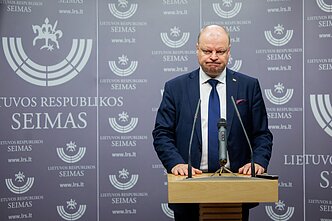










Lithuanian President Gitanas Nausėda has nominated his adviser, Irena Segalovičienė, for the post of state auditor, a watchdog overseeing the transparent use of government funds. While the ruling coalition has welcomed the move, the parliamentary opposition has raised alarm.
“It doesn’t look good,” Viktorija Čmilytė-Nielsen, head of the opposition Liberal Movement's parliamentary group, told the news agency ELTA on Monday.
“Appointing people directly from one’s closest circle, without any break or cooling-off period, is a particularly poor practice. It would be unfortunate if this became the rule rather than the exception,” she added.
This follows an ongoing debate over the so-called cooling-off period – during which former officials are temporarily distanced from public service – previously called for by Nausėda himself.
However, critics say the president does not apply the same standard to everyone and has repeatedly appointed people from his inner circle to high-ranking posts.
Previously, Nausėda was reluctant to reinstate Eimutis Misiūnas as a judge because he had served as interior minister and deputy defence minister during the tenure of the government led by the Lithuanian Farmers and Greens Union (LVŽS) in 2016–2020.
At the time, the presidential office argued that “individuals who left judicial service for political roles or appointments, and now seek to return after losing those positions,” do not meet the principles of political neutrality or motivational standards.
Former Foreign Minister Linas Linkevičius also had to delay his diplomatic career – he was appointed ambassador to Sweden three years after completing his two-term service as the foreign minister. Similarly, Raimundas Karoblis was without a position for several years after serving as defence minister.

However, Nausėda has not applied the cooling-off requirement to his advisers – former adviser Jūratė Šovienė was appointed chair of the Communications Regulatory Authority, Simonas Krėpšta joined the board of the Bank of Lithuania, and Kęstutis Budrys became foreign minister.
“This sets a very poor precedent,” said Mindaugas Lingė from the largest opposition group in parliament, the conservative Homeland Union (TS-LKD).
Former prime minister Ingrida Šimonytė went further, comparing Nausėda to US President Donald Trump.
“It seems Gitanas Nausėda is trying to outdo Donald Trump, who often nominated people for key state positions who could hardly be described as suitable – neither in terms of competence, ethics, nor understanding of the institutions’ goals and responsibilities,” she posted on social media.
Coalition government welcomes the nomination
However, the three-party governing coalition, which is on visibly better terms with President Nausėda than their predecessors, has welcomed the nomination.
“We, for our part, accept the submitted nomination and will discuss it within our factions. Irena Segalovičienė has the necessary competencies, she’s an experienced specialist, and I believe this is a strong nomination,” said Prime Minister Gintautas Paluckas.
He declined to comment on the president’s previous emphasis on the need for a political cooling-off period. “Only the president can explain what needs to be cooled or heated,” Paluckas said.
Saulius Skvernelis, speaker of the parliament and head of the Democrats “For Lithuania” party in government, said the presidential adviser post was not a political one.
“It is not linked to a political party or a political post. She is simply a presidential adviser whose knowledge and competence can be assessed. Whether she can maintain political neutrality – a requirement for the National Audit Office – is a matter of fact.
“If she were a party member or affiliated with a political force, such concerns might be justified. But it will be up to the Seimas to decide. The president has the prerogative and exclusive right to nominate, and our duty is to evaluate the nomination and make a decision,” he said.
The National Audit Office is the highest state audit institution responsible for overseeing whether state funds and property are managed and used lawfully, as well as monitoring the implementation of the state budget.

Newsletter
Every Friday morning.