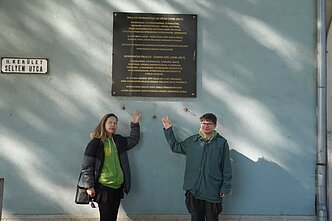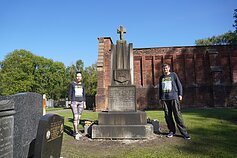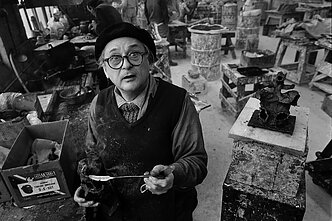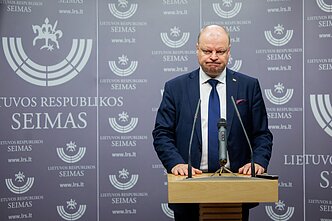










For seven years, Augustinas Žemaitis and Aistė Žemaitienė have been uncovering and documenting Lithuanian heritage across the globe with their Destination Lithuanian America project. This year, their expedition took a new turn, trading the roads of America for a two-month-long journey through Europe, uncovering over 100 Lithuanian heritage sites in 11 countries.
The result? A treasure trove of stories that highlight the indomitable Lithuanian spirit, from unique monuments and historic communities to the haunting remnants of displaced persons (DP) camps, Augustinas and Aistė share in a press release.
“Lithuanian heritage in Europe is as fascinating as it is diverse,” says Augustinas, comparing it to the well-documented Lithuanian history in the United States. “While smaller in scale, the depth of stories and cultural connections here are unmatched.”
Lithuanian DPs in Western Europe
According to Augustinas, Lithuanian heritage sites in Europe are both similar and different to those in the USA. “The sites created by the two large migration waves – the 1865–1914 First Wave and the WW2-era DP second wave – are comparable to the locations built in the USA by the same waves,” he says.
However, the size and numbers of these sites differ greatly.
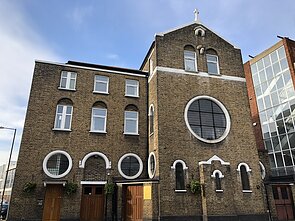
“While over 300,000 Lithuanians migrated to the USA with the pre-WW1 first wave, only some 10,000 migrated to Western Europe, with only the UK having a more sizeable community,” according to Augustinas. “Thus, 1910s London’s St. Casimir Lithuanian church is the only significant first wave Lithuanian heritage site in Europe.”

Meanwhile, the second wave, which mostly consisted of displaced persons, left a much bigger footprint in Europe, as thousands remained in the continent after the DP camps closed.
“The most interesting Lithuanian heritage sites in Western Europe were created by the DPs,” according to Augustinas, “including the unique February 16th Lithuanian gymnasium located in a massive German castle; St. Casimir Lithuanian College for priests in Rome; a Lithuanian burial chapel in Rome’s Verano cemetery where a signatory of Lithuanian independence Kazimieras Šaulys is buried; and V. K. Jonynas created the Lithuanian chapel in the very heart of Catholicism – Vatican’s St. Peter Basilica itself. Many of these places were significantly funded by Lithuanian-Americans.”
DP camps today
“One of our research goals was the DP camps,” explains Aistė. “We wanted to see for ourselves what remains of them today, is there anything that reminds of Lithuanians. Often, the information was difficult to collect. The situations we discovered tend to be threefold.”
In many cases, nothing Lithuanian remains – even if monuments had been built there, nobody could pinpoint these places anymore as everything was destroyed.
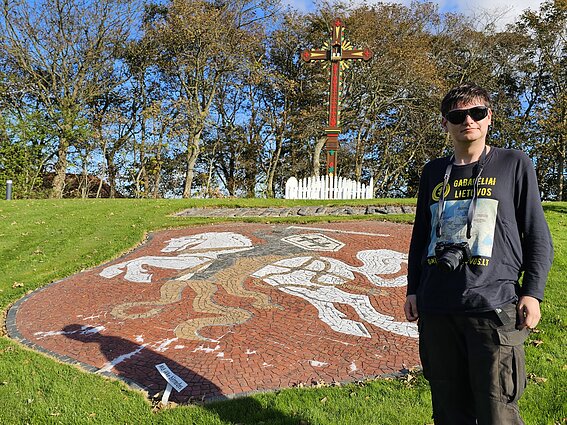
In a few cases, Lithuanian monuments survived, such as the Lithuanian cross in Augsburg that was built by the famous architect Jonas Mulokas who then continued to have an impressive career in the US designing many of its iconic Lithuanian-American churches, or a unique patriotic monument in Denmark’s DP camp saved by the Danish military.
“In some other cases, the descendants of the DPs or others built new memorials, such as the one on Detmold camp dormitory for its most famous inhabitant philosopher Vydūnas, or a recent Lithuanian cross in Wehnen camp where the original buildings no longer survive,” explains Augustinas.
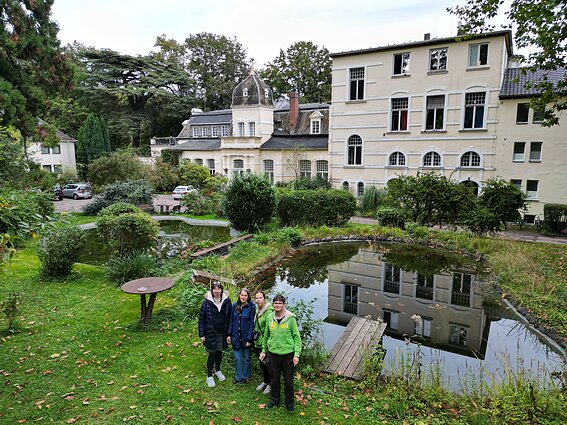
“For me, though, the most interesting and the saddest place was the Flossenburg camp,” adds Aistė. “There, the DPs were settled to live in a recently vacated Nazi concentration camp, with the crematorium and guard towers there intact to this day. However, this allowed the DPs to build a memorial for Lithuanians who recently had been killed there by the Nazis. At the time when Germany was not yet thoroughly de-nazified, this became one of the first memorials for Nazi victims in the entire country.”
Germany also served as a temporary stop to the pre-1914 first wave of migrants – Lithuanians mostly boarded America-bound ships in German ports, something commemorated in local emigration museums, such as the one in Bremenhaven.
From Punsk to Italy
Augustinas and Aistė also explored many unique types of Lithuanian heritage in Europe that don’t exist in the USA.
Likely the most impressive Lithuanian area in Europe is Poland’s Punsk and Sejny region which has the world’s only areas outside Lithuania with Lithuanian-speaking majorities.
“Unlike elsewhere in the world, Lithuanians mostly marry other Lithuanians here, perpetuating the culture. And while there are only several thousand of them, they built five museums and more monuments than we could hope to list.
“Some of the locations have no counterparts anywhere in the world, such as a prehistoric Baltic village reimagined and built by a local businessman, Lukoševičius, who was among the people we interviewed.”
People in Punsk and Sejny do not have emigrant forefathers, their families lived in the area for millennia and only the 1920 Polish-Lithuanian war finalised the region’s position within the borders of Poland.
“That history still divides the locals, with Poles and Lithuanians competing in building monuments representing their own beliefs about that history. While some Lithuanians feel hurt, they are allowed to have education in Lithuanian, something banned for similar prehistoric Lithuanian communities that existed in Russia and Belarus.”
Other unique Lithuanian heritage sites in Europe include centuries-old Lithuanian coats of arms that were left by Lithuanian noble families who lived in various key areas of Europe, from Poland to Florence.
One may find Vytis bas-reliefs in such world-famous places as the Paris island where its Notre-Dame Cathedral stands, or next to the Spanish steps in Rome.
“Paris became the centre of that Polish and Polish-speaking Lithuanian migration after the failed 19th-century uprisings to restore Poland-Lithuania,” explains Augustinas.
Paris also arguably has more famous Lithuanian graves than any other single European city, as it attracted famous artists. Žibuntas Mikšys, a Lithuanian graphic designer, is, for example, buried in the world-famous Pere-Lachaise cemetery, where the likes of Jim Morrison and Edith Piaf also rest.
Lithuanian artworks continue to proliferate in Europe. While regular monuments are beyond the scope of the Global True Lithuania project, it does include monuments that have Lithuanian motifs.
“The place that has the most of them is Paudorf area in Austria, where almost 10 of the Lithuanian-mythology-inspired wooden sculptures were erected during symposiums,” says Augustinas. “Though even more mystical is the story of the Perkūnas totem pole that suddenly appeared on the white cliffs of Dover, England, in 2023. Nobody knows who built it, the local press even nicknamed the author ‘Lithuanian Banksy’.”
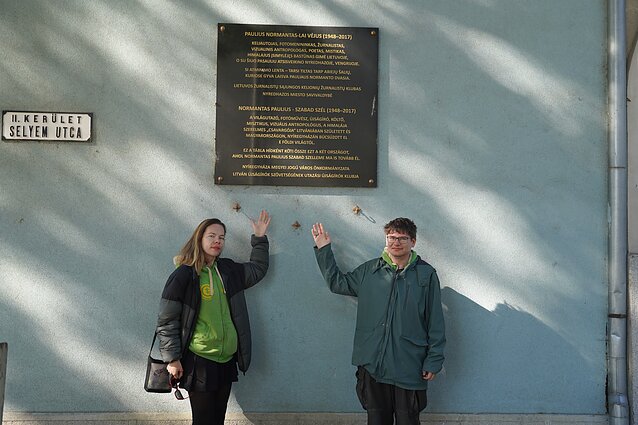
“Some of the Lithuanian communities in Europe are difficult to classify along the emigration waves,” he continues, mentioning the Lithuanian-Hungarian community in particular. Lithuanian monuments began to be built in the 1980s and the initial Lithuanian-Hungarians immigrated while Lithuania was still Soviet-occupied.
“As Hungary was also communist-ruled, emigration there was possible, especially for family reasons; still, life in Hungary was freer than in Soviet-occupied Lithuania.”
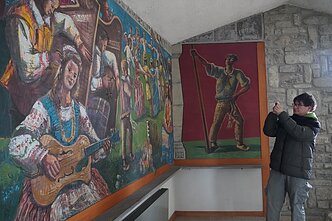
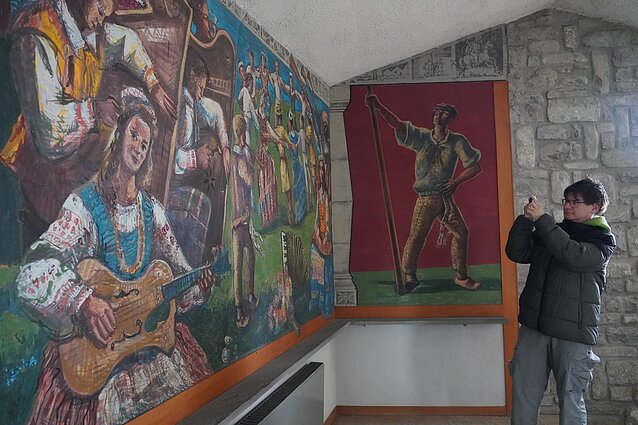
Then there are unique places created by non-Lithuanians, such as the Sala Lituania of Bardi, Italy, full of Lithuanian murals. While Bardi never had a Lithuanian community, the hall was inspired by the local son cardinal Samore, who had previously worked in interwar Lithuania, and a Lithuanian priest Vincas Mincevičius who worked with Samore.
New migrants and heritage
After Lithuania joined the European Union, mass emigration to the United States declined while Lithuanian migration to Western Europe reached enormous proportions. Did this lead to better preservation of the old heritage sites and proliferation of new ones?
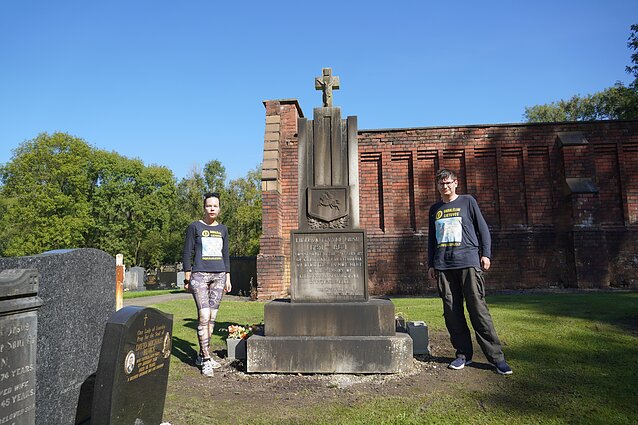
“This varies greatly from community to community, explains Augustinas. “Lithuanian migrants to the United Kingdom have been successful in taking care of DP Lithuanian cemetery zones that exist in Nottingham, Bradford, London, and Manchester, the latter two also hosting impressive Lithuanian monuments.”
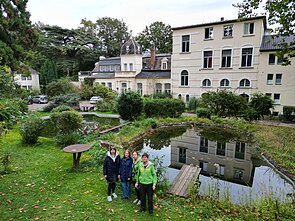
Meanwhile, the Lithuanian community in Switzerland has been especially successful in marking the Lithuania-related sites with commemorative plaques. They include a Lithuanian DP camp site and a villa where Lithuania’s national poet Maironis wrote some of his most famous poems.
The recent third wave of Lithuanian emigrants has also been instrumental in researching the stories of Italy’s and France’s Lithuanian heritage sites, publishing them online. They also took over some of the historical Lithuanian institutions, such as the February 16th gymnasium in Germany.
“During our field trip, we tried to inspire the mostly recent Lithuanian migrants in Europe to discover Lithuanian heritage sites, visit them, and care for them,” says Augustinas.
During the expedition, he gave seven talks and workshops to several hundred Lithuanians and met even more of them in person, recording interviews and hearing their stories.
“I try to spread the word about the impressive and well-taken-care-of Lithuanian heritage in the US and elsewhere, encouraging Lithuanians of Western Europe to create and cherish such heritage in their own home countries,” Augustinas says.
Further resources
As usual, the results of the Global True Lithuania field trip are published online in detail in numerous ways, accessible free of charge.
- The encyclopedia of Lithuanian heritage sites abroad has extensive articles about each Lithuanian-heritage-rich area and country worldwide. As the expedition is over, the encyclopedia will soon have extensive articles about each Lithuanian-heritage-rich area and country in Europe.
- Additional photos are regularly published on Facebook and Instagram accounts True Lithuania.
- While much of the information is bilingual, additional films and interviews are available in Lithuanian on the Youtube channel Gabalėliai Lietuvos and expedition diaries published here, as well as in the Lithuanian edition of the Draugas newspaper.
- Augustinas Žemaitis and Aistė Žemaitienė are soon to publish the book Lithuanian Landmarks in the USA with 950+ photos and 14 maps of the Lithuanian heritage sites in the US.

Newsletter
Every Friday morning.