








The Ukrainians stuck in the Russia-occupied territories of Ukraine testify to the daily fear they experience from the occupying power. The new authorities are destroying their identity, pushing those who do not have Russian passports out of their homes and threatening to take away their children. Soviet symbols also serve this purpose.
Halyna, a mother of two children, one of them disabled, and her cancer-stricken father are stranded in the Russia-occupied Zaporizhzhia region of Ukraine. Her name has been changed for safety reasons, and she has only communicated with journalists via text messages.
“In the last few days, I’ve read very disappointing news. People are being evicted from their homes if they don’t have a Russian passport. In Berdiansk, as of March 1, only those with a Russian passport will receive social benefits and humanitarian aid. In Kherson oblast, anyone without a Russian passport will be sent for filtration. All of this will come to us too. What will we do? We cannot buy anything because they don’t accept Ukrainian cards. We only receive funds from Ukraine. We don’t want to be traitors,” Halyna writes in one of her messages.
She eventually had to become a Russian citizen for the safety of her children. Halyna was threatened that she would lose her children if she refused the Russian passport.

At the beginning of October, she also wrote about the new reality in Ukrainian schools in Russia-occupied regions.
“Today at school, children and teachers were forced to celebrate the annexation of Zaporizhzhia to the Russian Federation,” she says in a message.
Halyna was interviewed by Alla Sadovnyk, a journalist at the Ukrainian public broadcaster Suspilne. She, as well as the LRT Investigation Team, together with an international team of journalists: Emiliano Bos (RSI), Christoph Bendas (ORF), Louise Jensen (DR), Belen López Garrido (EBU), Pilar Requena (RTVE), and Lili Ruta (EBU) – have gathered testimonies of people stuck in the temporarily occupied Ukrainian territories.
This investigation sheds light on the grim and often tragic everyday life in the Russia-occupied parts of Ukraine, as well as the Kremlin’s attempts to Russify the occupied territories.
Bringing back Soviet symbols
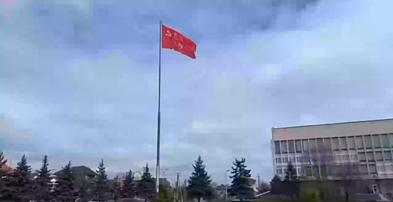
As a march sounds from a loudspeaker in early May 2022 in the occupied Ukrainian city of Melitopol, the occupiers hoist not the Russian but the Soviet flag – a red cloth emblazoned with the hammer and sickle.
That march, which eventually falls silent, is ingrained in the heads of the people born in the Soviet era. It is the Holy Struggle march released in the summer of 1941 as a propaganda tool to support the Soviets in the war against Nazi Germany.
The Soviet Union collapsed in 1991, but the Kremlin is again using Soviet symbols to consolidate its power in the occupied Ukrainian territories. The Soviet flag and march in Melitopol are just one example of this.

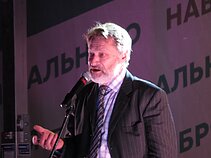
The Russian forces occupying eastern Ukraine are a terrifying amalgam of their historical predecessors, says Ukrainian historian Artem Petrik, who lived in Kherson under Russian occupation.
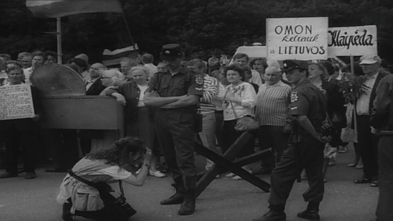
“What did we see when they came? A symbiosis of people who came for us during the times of Ivan the Terrible, prototypes of the Red Army soldiers of 1919 that Lithuania fought during the struggle for independence, and, of course, characters from Stalin times,” he says.
Petrik has been working at Lithuania’s Klaipėda University for several years. When the war broke out, he found himself in Kherson, where he was staying with his parents to work on his new book on the history of the Baltic states.
He couldn’t leave Kherson before the Kremlin forces came and remained there throughout the Russian occupation until November 2022. Petrik hid his identity, constantly changing homes; even those closest to him didn’t know where he was staying.
“If you wanted to keep your Ukrainian identity under the occupation, you faced imprisonment, torture, and death,” he says. “I had to hide all the time, and it was a very difficult but also very interesting experience.”
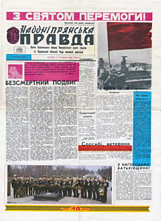
He survived the Russian occupation and is still collecting evidence of the Russification that is taking place in the territories controlled by Moscow. He shows a bundle of newspapers that were published in the occupied Kherson area.
In the spring of 2022, the Russian occupation authorities revived the publication of the local Duma official gazette, which had been defunct for some time. It kept its name, Naddnipriyanskaya Pravda, but in a Russified form. Throughout the newspaper’s history, including during the Soviet period, its name was spelt in Ukrainian.

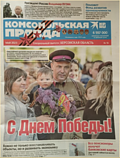
Alongside this journal, the Russian authorities started publishing Komsomolskaya Pravda, which was distributed across the Soviet Union until its collapse in 1991. Since then, the publication continued only in Russia and Belarus. Komsomolskaya Pravda is sanctioned in Ukraine and Canada for involvement in the deportation of Ukrainian children to Russia and the dissemination of propaganda and disinformation.
Both newspapers are examples of an official policy of Russification in the occupied Ukrainian territories, with the aim of assimilating these regions into Russia.
The pages of Komsomolskaya Pravda are decorated with the black-orange St George ribbon, a Soviet symbol of victory over fascism during the Great Patriotic War. In Baltic countries, the ribbon is considered a symbol of Russian imperialism and is banned.
The May 9, 2023, edition of Komsomolskaya Pravda of Kherson Region contains a huge congratulatory message on the occasion of Victory Day in the Great Patriotic War.
“Nothing will overshadow our most important celebration. In a land liberated from fascism 78 years ago, a new generation is now fighting a heroic war. We appreciate the heroism of our grandparents and are proud of the heroes of today,” the message reads.
On the left of the same page, there is an article on Russian President Vladimir Putin’s speech, which promised economic benefits for the disadvantaged. Almost every issue of the newspaper contains statements from Putin, and this particular one is almost entirely devoted to the visit of Sergei Kiriyenko, Deputy Chief of Staff of the Russian President.

According to the report, “During his visit to Kherson region, [Kiriyenko] discussed with local authorities the main directions of the region’s development, including modernisation of kindergartens, schools, and cultural institutions, preparation for the new academic year, children’s health, and strengthening the control over value education”.
Soviet symbols for new Russian Empire
Petrik says it is no coincidence that Soviet images, symbols, and narratives are transferred to the Russia-occupied Ukrainian territories.
“In simple terms, the Russians are looking for a chain, a rope to bind the peoples of the empire together. To do this, they use the old symbols and ideology of hatred,” the historian explains.
“When we are confronted with a change of political regime, there is usually a symbol workshop at the same time, as there is a search for symbols,” says Natalija Arlauskaitė, a politics professor at Vilnius University. “Usually, the symbols come from a variety of contexts, which can be both relevant in that environment, and sometimes they are born spontaneously.”
The raising of the Soviet flag to the sound of the Soviet march in occupied eastern Ukraine is precisely such a mix of symbols, she notes.
“It is a resource associated with that just victory, which is used in a new situation”, says Arlauskaitė. “It is used in combination with contemporary pop culture to create these hybrid constructions.”
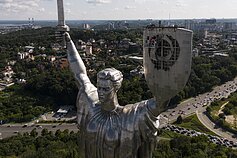
The Soviet symbols have survived longer in Ukraine than in the Baltic states. In the Ukrainian capital and elsewhere in the country, statues of Soviet figures and symbols were only recently removed from the public spaces.
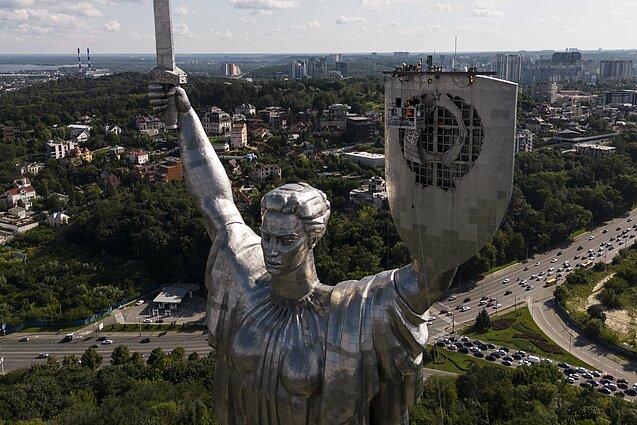
More than 60 monuments and other objects have already been demolished as part of the “decommunisation” process in Kyiv, according to Hanna Starostenko, deputy head of the city administration.
“Monuments and memorial plaques commemorating the Soviet and imperial past have no place in the capital”, she said according to the Euromaidan Press. “Together with experts and representatives of specialised institutions, we are carrying out extensive work to permanently remove from public space all those objects that glorify the aggressor country.”
Sovietisation of Ukraine
The current Kremlin regime is replicating the Soviet policies applied in the occupied Baltic states, first in 1940, and then in 1945, says Dmitry Oreshkin, a Russian political analyst who lives in exile in Riga.
“Of course, some differences can be found, but the Kremlin regime’s ambition is to homogenise the population. Stalin pursued this policy in a targeted way. He knew that to subjugate a nation, it was enough to destroy 2-3 percent of the most active, educated, and motivated people. And with the rest, you can do whatever you want,” he explains.
In the Baltics, the Soviet occupation began with the deportation and repression of indigenous populations. Russia’s current policy in Ukraine seems to be based on the same Soviet logic.
“The inevitable consequence of the occupation is the cleansing of the so-called hostile elements. [...] People must be singled out, expelled, and persecuted. As a rule, the most active people are local and do not speak Russian. So, efforts are made to attract migrants to take the place of the people who have been expelled or repressed and to make the population more loyal. This is commonly referred to as ethnic cleansing,” says Oreshkin.

The scholar is also reluctant to refer to what is happening in the occupied territories of Ukraine as mere Russification. Instead, Russia’s actions in the occupied lands of Ukraine seem to resemble the Sovietisation of Ukraine, he says.
“From the outside looking in, it is called Russification, but it was not all bad in Russia,” Oreshkin notes. “There were elections in Russia, but there were never elections in the Soviet Union. We are going back to the Soviet practice of fabricating everything. Violence, intimidation, and the creation of a new elite are happening fast. And the aim is the same – to keep power by any means necessary.”

Newsletter
Every Friday morning.