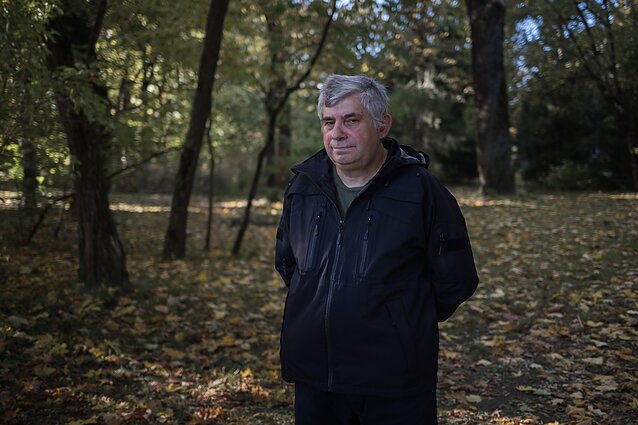













Rimas Armaitis has been fighting on Ukrainian frontlines since the beginning of the full-scale invasion. Recently, he was in Andriyivka in the Donetsk region, which was recaptured by Ukrainian forces. In an interview with LRT TV, he talks about how the war has become a tiring, emotionally exhausting routine.
“The worst thing is the drones, there are more of them than mosquitoes. It's practically impossible to tell where someone's drone is,” he said. “If there are more than three people in one place, it takes 10 to 15 minutes to get bombed. When you go out on a task, we work in pairs. The distance between one and the other is at least 50 metres, otherwise, if they notice you, they will shell you very quickly.”
Armaitis works as a sapper, with most of his tasks centred on demining paths for Ukrainian forces to advance, as well as clearing recaptured positions. The tactics they use have changed over the course of the war.
“We used to work with a protection group, but this year you cannot use them, you cannot go with more than two people. If a car comes, it brings you to a point, you get out quickly and it goes back because it is very easy to lose the transport [to a bombardment].”

Sappers also no longer accompany assault groups, according to Armaitis, as each attack leaves 20 to 30 percent of the group dead or wounded.
“Assault teams are now trained to detect mines and avoid them,” said Armaitis. “Our group [of deminers] is very small, two months ago there were six people, and now there are five left. If we went to every assault, we would be gone.”
According to Armaitis, the Russians leave behind minefields when they retreat. He recently escaped injury or even death only by a miracle – an undetected mine did not explode.
“There are times when they retreat and throw cluster mines on the area when the Ukrainians or our forces arrive, which is a bit more difficult. One thing is that they are dangerous, they have a destruction mechanism, but not all of them are destroyed,” said Armaitis.

“One of these moments was when [...] we were leaving the place and we did not see the seismic mine POM-3. I was walking first [and] for some miraculous reason it did not explode,” he added.
According to Armaitis, if you survive the first three months, war becomes a daily routine. Nevertheless, it becomes morally draining. Fatigue is also visible among Ukrainians.
“The fatigue is very high among everyone,” he said. “You are not afraid of the shots, you are not afraid of the shellings, you are not afraid of the explosions, but it gets more and more difficult.”
“It's the same with the Ukrainians, you can feel it when you talk to them, they don't look at what kind of village they are liberating anymore, they are just liberating. They just go and do their job,” he added.

Newsletter
Every Friday morning.