















The Civil Union Bill on gender-neutral civil unions, proposed by Lithuania’s ruling coalition, has a lot of shortcomings but is a step toward filling the current legal vacuum that discriminates against same-sex partners, human rights activists say.
On Monday, a new draft law on gender-neutral partnerships was registered at the Lithuanian parliament Seimas. It replaced the concept of the “same-sex partnership” with “civil union”.
Read more: Lithuanian parliament drops word 'partnership', proposes 'civil union' instead
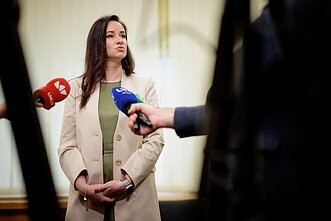
The new draft law is a “minimum standard”, according to Monika Antanaitytė of the Lithuanian Gay League, the LGBTQ rights organisation.
“Does it reflect the social reality that currently exists and [...] the needs of different families in their entirety? It certainly does not,” Antanaitytė said at a press conference, held by the Coalition of Human Rights Organisations, on Tuesday.
“However, the law at least sets a minimum standard, and a minimum standard is better than no standard at all and a complete legal vacuum,” she added. “Therefore, it would be cynical for the opposition not to support this bill.”

According to the activist, the main shortcomings of the bill are that it would not allow partners in a civil union to change their surname and that such a union would be registered with a notary rather than with civil registry offices.
“This implies a certain attitude towards this institution and the importance of the relations it regulates,” Antanaitytė said.
“On the other hand, from a legal technical point of view, this is a more orderly document that also hints at the regulation of family property, which would help resolve some issues related to obligations to creditors and would provide greater protection of [partners’] property,” she added.
Jūratė Juškaitė, director of the Lithuanian Centre for Human Rights, described the Civil Union Bill as “a starting point” that establishes partners’ rights, such as inheritance and information on each other’s health. However, the bill “lacks some things”, she said.

“The first thing is that the law does not talk about children living in same-sex families,” Juškaitė said. “It does not address or regulate in any way the issue that only one of the most important adults in a child’s life – either one’s mom or dad – can officially take care of the child.”
Margarita Jankauskaitė, an expert at the Centre for Equality Advancement, said that Lithuania is home to about 600,000 unmarried couples who need legal protection. These include heterosexual couples, whose relationships “are subject to various vicissitudes, challenges, and problems, such as domestic violence”.
“The general public expects the victim to cope with the situation by simply leaving the abuser,” Jankauskaitė said. “But how can this be done when there is such a huge regulatory gap in the legal system?”

Lithuania’s ruling coalition on Monday unveiled a new bill authorising civil unions for unmarried partners, including same-sex couples, in place of a draft law on partnerships that was rejected by the parliament last spring.
The initiators describe the new bill as a compromise aimed at securing broader support for the recognition of gender-neutral civil relationships.
Some opposition politicians reject the proposed draft law, saying that it is not different enough from the previous bill.

Newsletter
Every Friday morning.