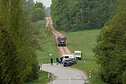





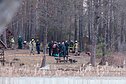





Polish farmers started a partial blockade of a road at the Lithuanian-Polish border on Friday morning. At the former Kalvarija-Budzisko border crossing point, trucks leaving Lithuania get diverted to a separate lane, and those that raise suspicions are directed to a special parking area where they are checked by officials.
According to BNS, around 30–40 protesters are present on the spot, watching as Polish police, customs, and road transport inspectors check the documents of the trucks. The procedure takes up to 5 minutes, no vehicles have been stopped as of Friday midday. There are no traffic jams on the road and cars can pass freely.
Karol Pieczynski, one of the organisers of the protest, says that the aim is not to block traffic, but only to draw attention to the problems of the agricultural sector. He says this is a new form of protest, which Poles have not used before.
“Today’s protest will look like we will be checking the trucks together with the Polish authorities, with the customs, with the transport inspectorate, to see what is being transported in them. We hope that Lithuanian farmers will join in soon, maybe not today, because we want to make sure what is in the trucks,” Pieczynski told journalists.

Pawel Iwaszko, another organiser of the protest at the border, says that several hundred tonnes of Russian grain may have entered Lithuania and Poland through Latvia.
“We have information that grain from Russia has entered Lithuania and Poland, and it was certainly several hundred tonnes because the grain was transported through Latvia. And from Latvia, they were delivered to Lithuania and then they were transported to Poland,” he told reporters at the border on Friday.
“We are checking that those trucks contain Ukrainian grain. They enter Lithuania from Poland, the documents are changed there and they enter Poland from Lithuania as European Union goods,” he added.

According to Iwaszko, the protesters do not want to disturb the population and business: “We are only checking whether these Ukrainian, Russian grains are entering, but this concerns not only farmers but also those who consume these products, the quality.”
One of the protesters, farmer Dariusz Ponichter, said he wanted to see what the lorries were carrying and how the officials were controlling it.
“We have one goal today and it is simple – we want to control the trucks and what they are carrying, we want to see how the officials work,” the farmer told reporters at the border.
“I am a young farmer, I have a number of loans, I started my work, today I am working and I am faced with this injustice, I am not respected, my work is not respected, I suffer, I can’t even pay my debts,” said Ponichter.
“I am here because the price of grain is lower and we are suffering because of it. [...] The grain that comes from Ukraine is not always of good quality and then it is in transit to Lithuania, from Lithuania to other European countries,” said another farmer, Radoslaw Paczesny.

Disagreements with EU policy
Polish farmers are not only protesting at the border, but also in the capital Warsaw, where they gathered a few days ago.
The main issues they are raising are the European Union’s environmental policy and the import of agricultural projects from Ukraine.
At the former Kalvarija-Budzisko border crossing, the protesters are planning to carry out checks on trucks going from Lithuania to Poland for a week.
“After the prime minister’s [Tusk’s] meeting with farmers, there are no agreements yet. They will be sought in the coming days. Our protest may therefore be even more necessary than before. Tomorrow we will act as agreed,” Karol Pieczynski, the organiser of the protest at the Lithuanian border, told BNS on Thursday evening.
He said transport checks are planned for a week around the clock, with farmers rotating “shifts” every 12 hours, and inspections will be carried out in conjunction with officers from various services.

“The customs and tax inspectorate, the police and the road transport inspectorate will be checking heavy goods vehicles such as curtain siders and silage trailers together with farmers,” said Pieczynski.
According to Daumantas Butkus, a journalist working at the Lithuanian-Polish border on Friday morning, the checks will take place in a specially designated area. It was still empty at around 08:00 on Friday morning.
Pieczynski told LRT RADIO on Thursday evening that the inspections would not cause any problems for light and passenger transport, which would be diverted to a separate lane.

“There is a lot of conflicting information which I would like to refute. I wouldn’t call it a blockade of the entire border – I would call it more intensive controls on both the Lithuanian and Polish sides.
“Cars and passenger cars will drive in one lane, trucks will be checked selectively, officers will indicate who has to stop for checks. Everyone else will continue without hindrance,” said the Polish farmers’ representative.
On the Polish side, the organiser of the protest said, checks will look at Russian and Ukrainian grain entering the country.
“Polish farmers want to check how much grain is actually crossing the border and what its origin is because there is a serious risk that grain from Russia, not only from Ukraine, will enter the country,” he said.

Deputy Interior Minister Arnoldas Abramavičius told LRT RADIO on Friday morning that the checks should not affect heavy vehicles up to 18 tonnes, although they could be stopped selectively.
“The Polish side confirms that state services will carry out the checks and not the farmers or protesters themselves. The protesters’ tractors, up to 100 tractors, will be parked on the side of the road,” said Abramavičius.
On the eve of the protest, representatives of the Lithuanian border guard service and the Lithuanian police said that they would be prepared for various scenarios and would monitor the situation.
“The police will be the main institution to direct the flows, regulate traffic, ensure public order on the territory of the country [Lithuania]. There is no checkpoint there, so the border guards are not on permanent duty, but if the police need help, if there are queues, there will be several border guards there,” Giedrius Mišutis, a spokesman for the State Border Guard Service, told BNS.

Vilmantas Vitkauskas, the head of the National Crisis Management Centre (NKVC), said on Thursday that he would go to the border on Friday morning with a delegation and would be at the scene at the start of the road blockade.
Polish farmers are also blocking border crossings and motorways to Ukraine to protest against what they say is unfair competition for goods entering the Polish market from its war-torn eastern neighbour.
After invading Ukraine, Russia blocked important Black Sea trade routes through which Ukrainians used to export their agricultural products. In order to help Kyiv economically, in 2022 the European Union lifted tariffs on Ukrainian goods transiting through the 27-nation bloc.
However, due to logistical problems, much of Ukraine’s grain exports have been concentrated in Poland, which depresses prices for local producers.
Tensions between Poland and Ukraine are rising as a result of border blockades and a dispute over grain. There have been at least four incidents of Polish farmers spilling Ukrainian grain from lorries and freight trains.

Newsletter
Every Friday morning.